Perimeter Security Systems
High-Security Chain Link Systems
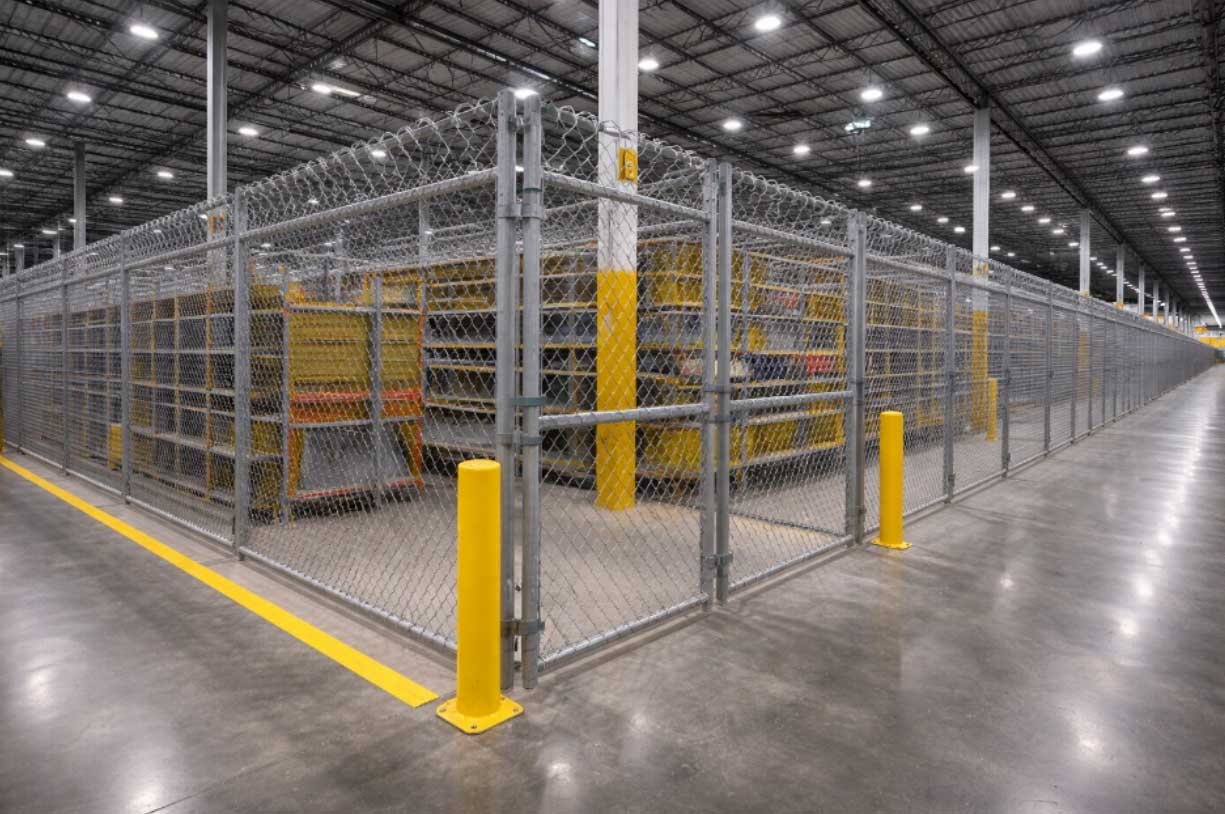
Commercial & Industrial Grade — Specified, Tensioned, and Documented to Public Sector Standards
CSI Division 32 31 13 — Chain Link Fencing | ASTM A392 / ASTM F668 / ASTM F1554 Compliant | Serving General Contractors on Public Procurement Projects
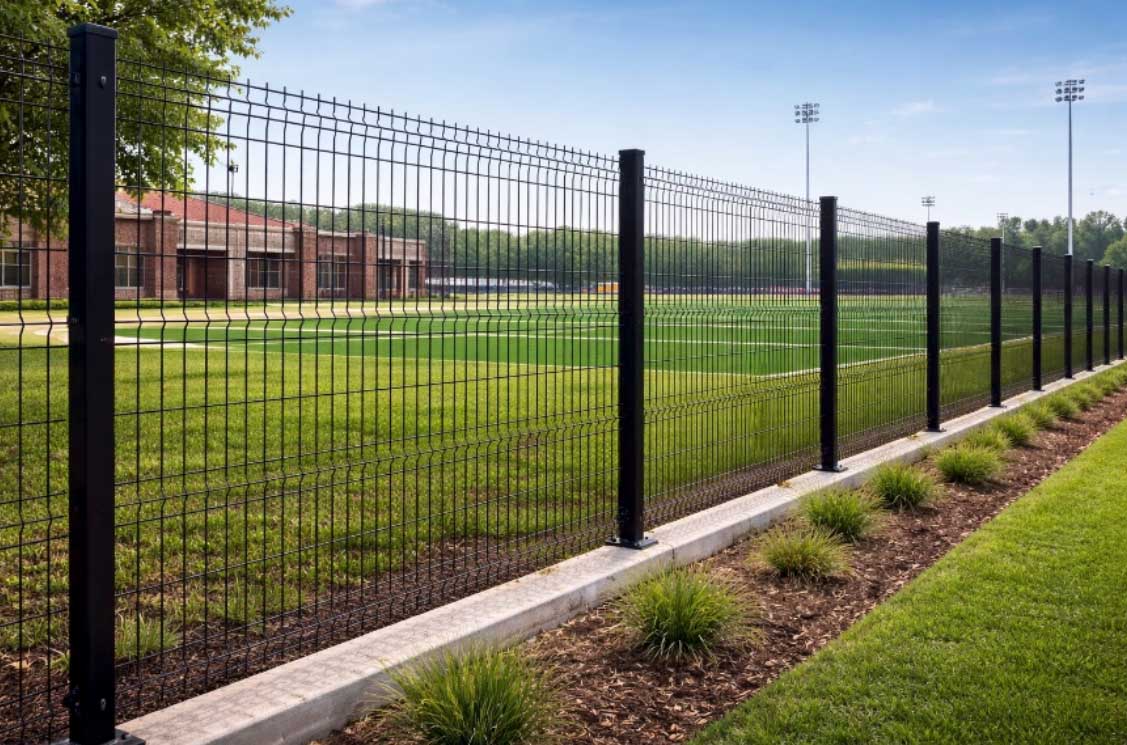
At Secure Public Fence, we install commercial and industrial grade chain link fence systems for public sector projects — school campuses, correctional facilities, transit yards, utility infrastructure, municipal storage areas, athletic complexes, and government perimeters. Chain link is the highest-volume fencing material in public construction, and it is also the most frequently under-specified and under-installed by contractors who don't understand the difference between residential and commercial grade. We work exclusively as a fence subcontractor to General Contractors. Every chain link installation we deliver is built to the commercial grade specified — correct wire gauge, correct post schedule, correct tension, correct coating — with the documentation package your public project requires.
Commercial Grade vs. Residential Grade — Why It Matters on Public Projects
The single most common failure point in chain link fence scopes on public projects is the substitution of residential-grade materials for commercial-grade specifications. A PM reviewing submittals needs to know the difference — and needs a fence sub who won't cut corners on material grade.
SPEC ELEMENT | RESIDENTIAL GRADE | COMMERCIAL / PUBLIC GRADE |
|---|---|---|
Wire Gauge | 11 ga (0.120") | 9 ga (0.148") or 6 ga (0.192") — per spec |
Mesh Opening | 2-1/4" diamond | 2" diamond standard; 1-3/4" available for high-security |
Line Post Diameter | 1-5/8" OD | 2" OD minimum; 2-1/2" or 3" for heights 8'+ |
Terminal Post Diameter | 2" OD | 3" or 4" OD — corner, end, and gate posts |
Post Wall Thickness | 0.065" (light) | 0.154" to 0.203" Schedule 40 |
Top Rail | 1-3/8" OD | 1-5/8" OD minimum; 1-7/8" for industrial |
Tension Wire | Often omitted | Required bottom and top — per ASTM F668 |
Coating | Galvanized (light) | Class 1, 2, or 3 galvanized — or PVC-coated per spec |
Post Embedment | 30" concrete | Engineered per height, wind zone, and soil conditions |
Barbed Wire Arms | Single strand | 3-strand barbed wire extension arms — per security class |
⚠ Why This Table Matters for Your Bid When a public spec says 'commercial grade chain link,' it is referencing ASTM F668 and ASTM A392 — not the material at your local big-box store. We review the spec section with you before bid day and confirm the exact material schedule. If the spec is ambiguous, we issue an RFI before bid submission so your price reflects the correct scope. Substituting residential grade on a public project creates warranty exposure, owner rejection risk, and punch list liability — none of which belong on your project. |
|---|
Technical Specifications
CSI DIVISION 32 31 13 — CHAIN LINK FENCING | COMMERCIAL & INDUSTRIAL GRADE | PUBLIC SECTOR STANDARD
COMPONENT | SPECIFICATION |
|---|---|
CSI Reference | Division 32 31 13 — Chain Link Fencing |
Fabric Standard | ASTM A392 (galvanized) / ASTM F668 (PVC-coated) — commercial and industrial grade |
Wire Gauge | 9 ga (0.148") standard commercial; 6 ga (0.192") industrial/high-security; 11 ga residential (not used on public projects) |
Mesh Opening | 2" diamond standard; 1-3/4" for high-security; 3/8" or 5/8" welded wire mesh for maximum security |
Fabric Height | 4' to 12' standard; custom heights per spec and engineering |
Line Posts | 2" OD Schedule 40 galvanized steel — 2-1/2" or 3" for heights 8' and above |
Terminal Posts | 3" OD (corner, end, pull) / 4" OD (gate frame posts) — Schedule 40 galvanized |
Top Rail | 1-5/8" OD commercial; 1-7/8" industrial — ASTM F1083 galvanized pipe |
Post Spacing | 10' O.C. standard — reducible to 8' for high-security or per engineering |
Post Embedment | Concrete-set per ACI 318 — PE-stamped footing calcs for heights 8'+ or high wind zones |
Tension Wire | 7 ga coil spring tension wire top and bottom — ASTM A824 Class 1 zinc coat minimum |
Tension Bands | Commercial-grade pressed steel — minimum 3 per 10' section; 5 for 10' fabric |
Coating Options | Class 1, 2, or 3 galvanized (ASTM A392) — or PVC-coated over galvanized (ASTM F668) in Black, Green, or Brown |
Top Finish Options | Barbed wire (3-strand ASTM A121), Razor ribbon / concertina wire, Barbed tape — per security class |
Gate Hardware | Commercial-grade hinges, fork latches, drop bars — sized per gate width and security requirement |
Standards | ASTM A392, F668, F1554, F1083, A121, A824 — CPTED guidelines — IBC wind load compliance |
Security Classification & Topping Options
USE THIS TABLE TO ALIGN SCOPE WITH OWNER'S STATED SECURITY REQUIREMENTS DURING BID REVIEW
SECURITY LEVEL | FABRIC / POST SCHEDULE | TOP TREATMENT & TYPICAL APPLICATIONS |
|---|---|---|
Standard Commercial | 9 ga, 2" mesh, 2" line / 3" terminal | No topping or single-strand barbed wire — parks, school general perimeters, municipal storage, athletic fields |
Medium Security | 9 ga, 2" mesh, 2-1/2" line / 3" terminal, 3-strand barbed wire arms | 3-strand 45° outward-leaning barbed wire — school secure perimeters, transit yards, public works facilities |
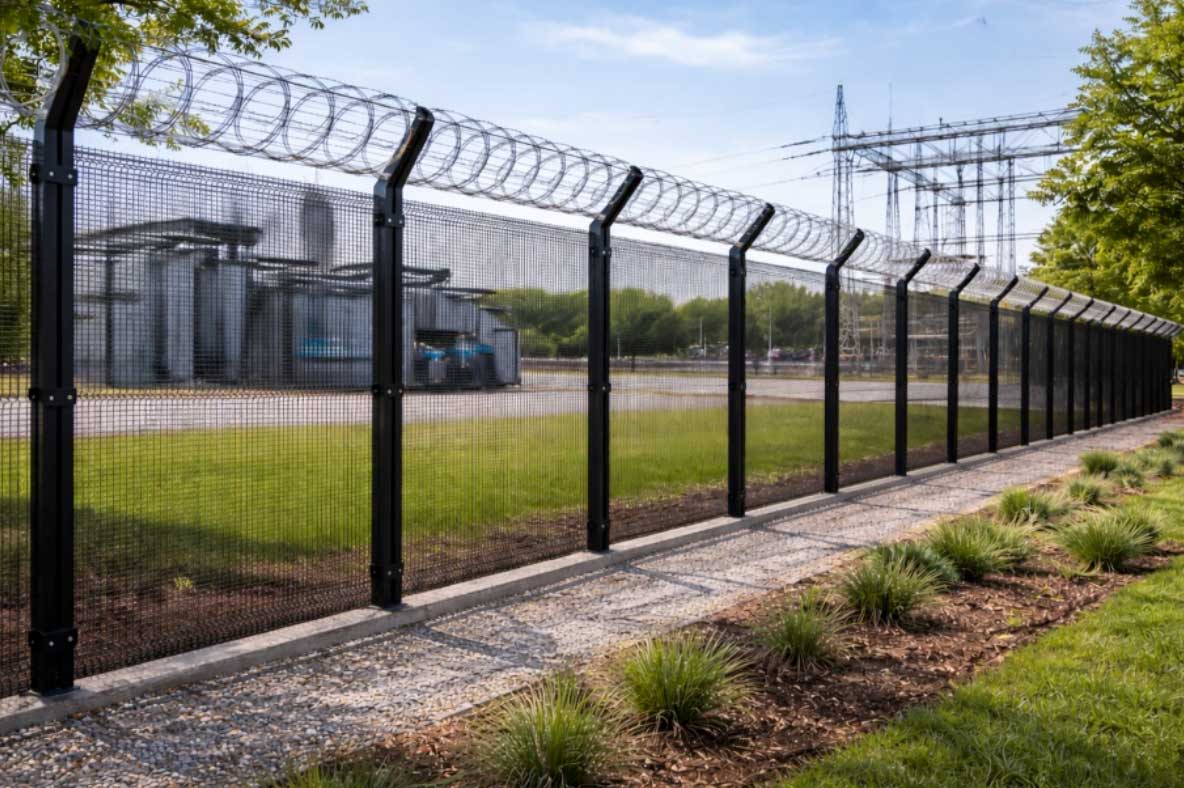
High Security | 6 ga, 2" or 1-3/4" mesh, 3" line / 4" terminal, barbed tape | Concertina / razor ribbon — correctional perimeters, utility substations, water treatment, government secure zones |
Maximum Security | 6 ga, 1-3/4" or 3/8" welded mesh, 4" line / 6" terminal, dual barbed tape | Double-coil razor ribbon, climb-detection cable systems — federal facilities, critical infrastructure, detention centers |
Anti-Ram Perimeter | Standard fabric + crash-rated bollard integration | Vehicle barrier posts integrated with chain link fabric line — courthouses, federal buildings, transit hubs (per ASTM F2656 / DOS SD-STD) |
🔒 Barbed Wire vs. Razor Ribbon — What the Spec Actually Requires Public specs frequently reference 'barbed wire' generically. There is a significant difference: standard 3-strand barbed wire (ASTM A121) is a deterrent. Razor ribbon / barbed tape (ASTM F1664) is a high-security barrier. We confirm the correct interpretation with the A&E team before bid submission. Specifying the wrong topping type creates either a security deficiency (under-spec) or a change order exposure (over-spec). Razor ribbon and concertina installations also carry additional safety protocol requirements for occupied sites that we implement as standard practice. |
|---|
Gate Systems for Public Facilities
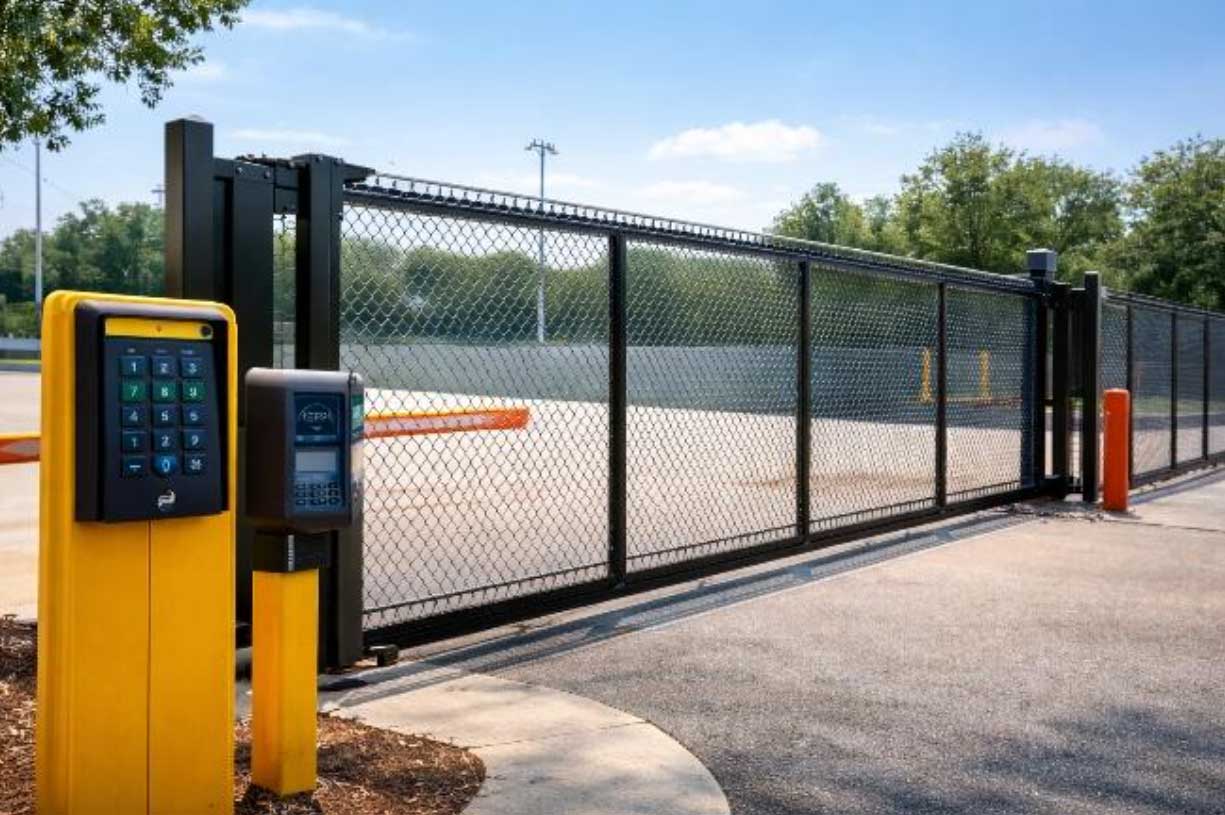
Chain link gate systems on public projects range from simple pedestrian walk gates to wide-span dual swing vehicle gates and automated slide gates for access control integration. Each type carries its own hardware schedule, structural requirements, and documentation needs.
GATE TYPE | TYPICAL WIDTH RANGE | PUBLIC FACILITY APPLICATION |
|---|---|---|
Pedestrian Walk Gate | 3' to 4' single leaf | School entries, park access, utility enclosures, maintenance access points |
Single Swing Vehicle Gate | 10' to 20' | Municipal yards, public works facilities, utility stations — manual or automated |
Dual Swing Vehicle Gate | 20' to 40' combined | Transit yards, correctional facilities, large public campuses — manual or automated |
Cantilever Slide Gate | 10' to 60'+ | High-use vehicle entries, bus/rail maintenance yards, government secure compounds — eliminates ground track for high-traffic clearance |
Rolling/Track Slide Gate | 10' to 40' | Budget-option vehicle entry for lower-traffic facilities — school service gates, park maintenance access |
Bi-Fold / Vertical Lift Gate | Per structural engineering | Space-constrained entries, high-security facilities — typically paired with automated access control |
⚙ Gate Operator & Access Control Coordination Automated gate systems on public projects require early coordination with the electrical subcontractor for conduit rough-in, operator mounting, and control panel location. We provide gate operator mounting details, required conduit sizing and routing, and loop detector location to your electrical sub before rough-in begins — preventing conflicts that generate rework and RFIs. We do not install electrical. We ensure the civil and structural scope is complete and ready for your electrical sub to finish without structural modifications. |
|---|
Where High-Security Chain Link Gets Specified in Public Projects
Chain link is the most widely specified fence system in public construction — it appears across more project types than any other material. The difference between a reliable fence sub and a problem sub is knowing which grade the project actually requires.
FACILITY TYPE | TYPICAL CHAIN LINK SCOPE |
|---|---|
K-12 Schools | Athletic field perimeter (9 ga, 10'+ height), secure campus perimeter (9 ga barbed wire), portable classroom enclosures, HVAC/utility yard screening. |
Higher Education | Parking structure perimeters, utility yard enclosures, research facility security zones, athletic complex surrounds — typically 9 ga commercial with varied topping. |
Parks & Recreation | Athletic field backstops and sideline fencing, dog park enclosures, court surrounds (tennis, basketball, pickleball), maintenance yard screening. |
Transit Infrastructure | Bus yard perimeters, rail maintenance facility security, station utility enclosures — 9 ga or 6 ga with barbed wire or razor ribbon per security tier. |
Correctional Facilities | Minimum-medium security perimeters — 6 ga, 1-3/4" mesh, razor ribbon top and bottom, climb-detection cable, with or without intermediate patrol fence. |
Utility & Infrastructure | Water treatment perimeters, pump stations, electrical substations, communication facilities — 6 ga high-security, NERC-CIP perimeter compliance documentation. |
Municipal Facilities | Public works yards, fleet storage, equipment compounds, solid waste facilities — commercial grade, barbed wire topping, wide-span vehicle gates. |
Athletic Complexes | Baseball/softball backstops and outfield fencing, multi-sport facility perimeters, track and field surrounds — specialized post schedules and fabric heights. |
Compliance & Documentation
CSI 32 31 13 | ORGANIZED TO YOUR PROJECT'S SPECIFICATION FORMAT — FIRST SUBMITTAL, NO RE-SUBMISSIONS
Chain link submittals on public projects go beyond a cut sheet and a material list. ASTM certifications for fabric, post pipe, and hardware; PE-stamped structural calcs for taller installations; and coating system documentation are all expected. Our packages are built for public projects from day one.
Pre-Construction Submittals
| During Construction
Project Closeout Package
|
Installation on Active Public Sites
Chain link on public projects is frequently installed on occupied campuses, active transit facilities, and operating utility sites. Our field teams are trained for the full spectrum of public sector site conditions.
Phased Installation & Security Continuity On occupied school campuses, correctional facilities, or secure government sites, we plan removal and reinstallation in phases that maintain continuous perimeter security throughout construction. Temporary fencing and security bridging protocols are included in our installation plan. Athletic Field & Sports Complex Sequencing Athletic fence installations require precise coordination with site work, grading, and field preparation. We sequence installation around your civil and landscaping subs to avoid footing conflicts and maintain access for equipment. Underground Utility Coordination All post locations confirmed with 811/Dig Safe before any excavation. We coordinate utility conflicts with your site superintendent before they become RFIs. Post locations adjusted and documented in shop drawing revision prior to installation. | Occupied Facility Protocols For active schools, parks, and transit facilities, we implement OSHA-compliant safety perimeters, work-hour protocols, and pedestrian separation during installation. No open excavations left unprotected overnight. Traffic Control (MOT) For installations adjacent to active roadways, parking areas, or loading docks, we provide and manage Maintenance of Traffic setups coordinated with your site safety plan and local municipality permit requirements. Davis-Bacon & Prevailing Wage Compliance All applicable projects executed in full prevailing wage compliance. Certified payroll records maintained and submitted on your required schedule. Our workforce is fully documented — no compliance exposure on your project. |
Warranty Coverage
All warranties provided in written form as part of the project closeout package, transferable to the project owner upon substantial completion. Extended warranty options available for high-security and critical infrastructure projects.
COVERAGE | DURATION |
|---|---|
Workmanship (Labor) | 2 Years |
Commercial Grade Fabric & Posts | 5 Years — Material Defect |
Class 1 Galvanized Coating | 5 Years — Corrosion Protection |
Class 2 or 3 Galvanized Coating | 10 Years — Corrosion Protection |
PVC-Coated Fabric (ASTM F668) | 5 Years — Coating Adhesion & Color Retention |
Gate Hardware — Manual | 2 Years Parts & Labor |
Gate Operators — Automated | 1 Year Parts & Labor + Manufacturer Warranty (typically 3–5 years) |
Barbed Wire / Razor Ribbon Topping | 2 Years — Material and Installation |
Working With Us — Subcontract Process
Chain link is frequently a fast-track scope on public projects. We are set up to move quickly — from bid to mobilization without the delays that come from a fence sub who can't keep up with a public project schedule.
01 | BID PHASE Send us the fence spec section (CSI 32 31 13), site plan with fence layout, and bid date. We confirm material grade (commercial vs. industrial), security classification, and top treatment from the spec — and return a complete scope letter and hard bid within 3 business days. We flag any material grade ambiguity before bid day. |
02 | AWARD & EXECUTION Upon award, we execute your subcontract, provide COI within 24 hours, and submit our full submittal package within 10 business days of NTP. Commercial grade chain link materials are typically available within 2–3 weeks from approved submittals. |
03 | SCHEDULING We provide a detailed installation schedule coordinated with your site superintendent. Chain link installs are sequenced around active site operations and phased for security continuity on occupied facilities. |
04 | CHANGE ORDERS CO pricing within 48 hours. We use your preferred CO format and track all T&M work with daily authorized superintendent signatures. Material grade upgrades, additional topping runs, and gate additions are priced from our published unit cost schedule. |
05 | CLOSEOUT Complete closeout package — as-builts, ASTM mill certs, warranties, lien releases, gate operator O&M manuals — delivered within 5 business days of substantial completion. |
Frequently Asked Questions — For Project Managers
Q: The spec says 'commercial grade chain link' — what gauge and post schedule does that mean? A: It typically means 9 gauge fabric (ASTM A392), 2" OD Schedule 40 line posts, and 3" OD terminal posts minimum. However, 'commercial grade' is not always precisely defined in every spec section. We review the spec with you before bid day, confirm the interpretation, and if it's ambiguous, we help draft an RFI to the A&E team so your price reflects the correct scope — not an assumption that creates change order exposure. |
Q: How do you handle barbed wire on occupied school campuses? A: Carefully and with a documented protocol. Barbed wire and razor ribbon installations on occupied sites require OSHA-compliant exclusion zones, directional sequencing away from occupied areas, and end-cap termination of all cut wire ends at the end of each work day. We include these protocols in our installation plan, which we submit to your superintendent before mobilization. |
Q: Can you integrate with automated access control systems on vehicle gates? A: Yes — and we flag the coordination requirements early. We provide gate operator mounting details, conduit stub-out sizing and location, loop detector placement, and control panel mounting to your electrical sub before rough-in. We coordinate the structural gate scope with the access control vendor's requirements so there are no surprises at equipment installation. |
Q: What is the difference between a cantilever slide gate and a rolling slide gate — and when does the spec require each? A: A cantilever gate uses no ground track — the gate is supported by overhead rollers mounted to a structural post and counterbalanced. It is the preferred specification for high-use vehicle entries, bus and rail yards, and any location where a ground track would be obstructed by grade changes, snow removal operations, or heavy vehicle traffic. A rolling gate uses a ground track and is a cost-effective option for lower-traffic locations with clean grade. We review the specified gate type with you at bid scope review and flag if the site conditions conflict with the specified system. |
Q: Do you self-perform all chain link installation? A: Yes. We self-perform all chain link fence and gate installation with our own trained crews. No sub-tier labor on your project. Our crews are experienced on public sector sites — school campuses, transit facilities, correctional perimeters, and utility infrastructure — and understand the site safety and access protocols these projects require. |
Download Our High-Security Chain Link Catalog
Our Chain Link Product Catalog includes the full commercial and industrial grade material schedule, security classification matrix, gate system details, coating system specifications, ASTM reference guide, and submittal-ready product data sheets — everything your estimating team needs to scope, bid, and execute chain link work on public projects.
📄 Chain Link Product Catalog Includes:
| 📋 Capabilities Statement Includes:
|

FENCING SYSTEMS