Access Control Systems
GATES & CONTROLLED ACCESS
Commercial-Grade Gate Systems Engineered for Public Sector Access Control — From School Campuses to Critical Infrastructure
CSI Division 32 31 13 / 32 31 26 — Gates & Access Hardware | TEA 19 TAC §61.1031 | NERC CIP-006 | IBC / NFPA 101 Life Safety | Serving General Contractors on Public Procurement Projects
At Secure Public Fence, we install commercial-grade gate and controlled access systems for the full range of public sector facility types in Texas — K-12 and higher education campuses, correctional facilities, water and utility infrastructure, transit and public works yards, government campuses, and municipal facilities. Our scope covers the structural gate system, the operator and hardware, and the coordination with your electrical subcontractor and the owner's access control integrator. Every gate system we install is documented to the standard the public owner's compliance program requires.
🚨 Texas Legislative Context — Why Gate & Access Control Scopes Have Grown Dramatically Since 2022 Following the Robb Elementary School shooting in Uvalde on May 24, 2022, the Texas Legislature passed House Bill 3 (HB 3, effective September 1, 2023) and the Texas Education Agency adopted School Safety Standards Rule 19 TAC §61.1031 (May 2023). These rules require all Texas public school instructional facilities to have access points secured by design, maintained to operate as intended, and appropriately monitored — with locked gates featuring emergency egress hardware and features that prevent opening from the exterior without a key or combination mechanism. To fund compliance, the State of Texas appropriated $1.1 billion through the 2023-2025 Safety and Facilities Enhancement (SAFE) Grant, with a minimum $200,000 allocation to every Texas school district. The result: every Texas public school district is now executing or planning gate and perimeter access control upgrades. For General Contractors bidding K-12, higher education, and public safety projects in Texas, gate and controlled access is no longer a minor scope item. It is a primary driver of public fence contract value — and it requires a subcontractor who understands both the physical gate system and the regulatory compliance documentation it must support. |
|---|
At Secure Public Fence, we install commercial-grade gate and controlled access systems for the full range of public sector facility types in Texas — K-12 and higher education campuses, correctional facilities, water and utility infrastructure, transit and public works yards, government campuses, and municipal facilities. Our scope covers the structural gate system, the operator and hardware, and the coordination with your electrical subcontractor and the owner's access control integrator. Every gate system we install is documented to the standard the public owner's compliance program requires.
Our Scope — What We Install and What We Coordinate
Gate and controlled access projects involve multiple subcontractor scopes that must be precisely coordinated. Defining those boundaries at bid time prevents scope gaps, change orders, and field conflicts that delay project completion. Here is how we define our scope and what we coordinate with your other subs.
SECURE PUBLIC FENCE INSTALLS | WE COORDINATE — NOT SELF-PERFORM | REQUIRES EARLY COORDINATION |
|---|---|---|
Gate structural frame — all types, sizes, and materials | Electrical service to gate operator (electrical sub) | Conduit stub-out location and sizing — before rough-in |
Gate infill panels — chain link, welded wire, ornamental steel, precast concrete | Access control electronics — card readers, keypads, intercoms (security integrator) | Card reader mounting post structural details — before fabrication |
Gate posts, foundations, and anchor systems | CCTV and surveillance integration (security integrator) | Loop detector location and conduit — before concrete/paving |
Gate operators — slide, swing, vertical lift, bi-fold (mechanical installation) | Solar power systems for remote gates (electrical sub) | Operator mounting structure — before gate fabrication |
All hardware — hinges, latches, locks, drop bars, exit devices | Crash-rated bollards integrated with gate system (civil/structural sub) | Anti-crash/anti-ram foundation design — PE-stamped, before excavation |
Emergency egress hardware — panic bars, breakaway latches, Knox boxes | Wireless intercom and PA system integration (low-voltage sub) | Emergency egress hardware selection — confirm AHJ requirements before order |
Anti-tailgating / access control integration mounting provisions | UPS and battery backup for operators (electrical sub) | UPS enclosure mounting structure — before gate fabrication |
Vehicle barriers — bollards, crash beams (structural fence scope) | Fire alarm integration for gate release on emergency (fire alarm sub) | Fire alarm gate release wiring — early coordination with FLS engineer |
⚙ Why We Define This at Bid — Not in the Field The most expensive gate-related change orders on public projects come from scope gaps at the boundary between the fence sub, the electrical sub, and the security integrator — particularly around conduit stub-outs, operator mounting provisions, and loop detector locations. We produce a Gate Coordination Drawing at the start of pre-construction — documenting every conduit stub-out location, loop detector box location, card reader post mounting detail, and operator power connection point — and distribute it to your electrical sub and security integrator before any underground rough-in begins. This single document eliminates the three most common sources of gate-related field RFIs on public projects. |
Gate Systems — The Complete Public Sector Catalog
EVERY TYPE BELOW IS AVAILABLE IN CHAIN LINK, WELDED WIRE PANEL, ORNAMENTAL STEEL, OR PRECAST CONCRETE INFILL — MATCHED TO THE ADJOINING FENCE SYSTEM
Vehicular Gate Systems
GATE TYPE | KEY SPECIFICATIONS | PRIMARY PUBLIC FACILITY APPLICATION |
|---|---|---|
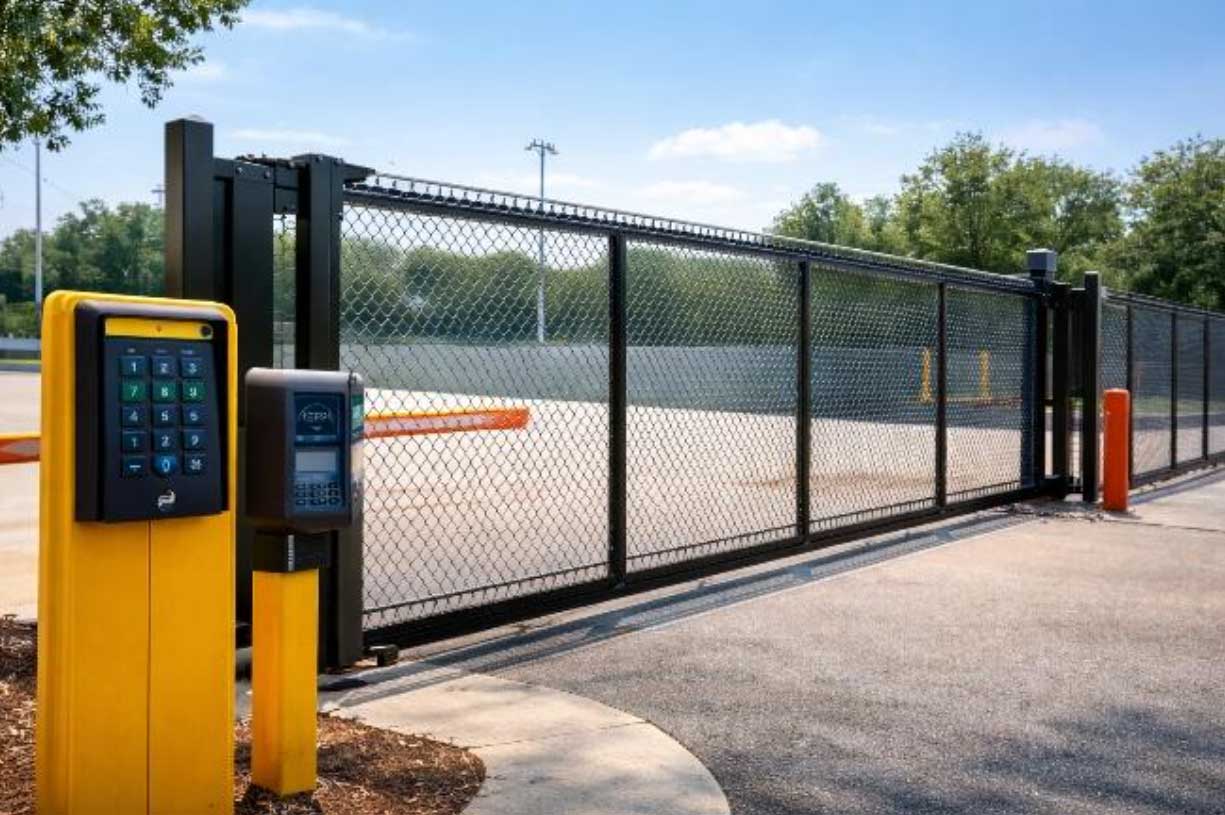
Cantilever Slide Gate | No ground track — supported by overhead cantilever rollers; structural post PE-stamped; counterbalance ratio per width and weight; single or dual motor configurations | Preferred for high-frequency vehicle entry — transit yards, bus maintenance, school service entries, utility facilities, government compounds. No ground track = no snow/debris obstruction, no threshold trip hazard, and no track vulnerability for security applications. Standard choice for TEA-compliant school vehicle gates. |
V-Track Rolling Slide Gate | Ground-embedded V-track; gate rolls on bottom-mounted rollers; simpler structural requirement than cantilever; lower first cost | Lower-frequency vehicle entries — municipal storage yards, park maintenance access, public works equipment compounds. Not recommended for security-rated applications where ground track creates a bypass vulnerability. |
Single Swing Vehicle Gate | 10' to 20' single leaf; structural pivot post (4" OD Schedule 40 minimum); heavy-duty commercial hinges; drop bar or fork latch rated to gate weight | Municipal utility entries, park maintenance gates, school secondary vehicle access — manual or automated. Requires clearance radius for swing arc; not suitable for constrained entries. |
Dual Swing Vehicle Gate | 20' to 40' combined opening; paired swing leaves; anti-sag diagonal brace on each leaf; counterbalance for automated applications; synchronized dual operators | Transit vehicle entries, correctional facility vehicle sally ports, government secure compound main access — wide span without cantilever complexity. Must account for wind load on open leaves. |
Bi-Parting Cantilever Slide Gate | Two opposing cantilever leaves meeting at centerline; synchronized dual operators; structural PE-stamped for combined span loads | Wide-span secure entries needing minimal open footprint — hospital ambulance bays, correctional main entry, transit bus portals. Faster cycle time than single cantilever on wide spans. |
Vertical Lift Gate | Gate rises vertically on guide rails; structural tower frame PE-stamped; counterbalance or hydraulic lift; rated for full open/close cycle under wind load | Space-constrained entries where no swing or slide clearance is available — building-integrated entries, covered parking structures, corridor entries. Highest first cost; lowest footprint. |
Crash-Rated / Anti-Ram Vehicle Gate | ASTM F2656 / DOS SD-STD-02.01 rated; certified to specific vehicle weight and impact speed; structural anchorage engineered to crash load; rated operator system | Federal facilities, courthouses, transit hubs, government campuses where vehicle attack is a design threat. Rating certificate required — not self-declared. Coordinated with anti-ram bollard line on same entry. Texas DPS and federal GSA specifications reference ASTM F2656. |
Pedestrian Gate Systems
GATE TYPE | KEY SPECIFICATIONS | PRIMARY PUBLIC FACILITY APPLICATION |
|---|---|---|
Standard Pedestrian Walk Gate | 3' to 4' single leaf; galvanized or powder-coated steel frame; commercial-grade hinges and spring-loaded self-closer; panic-rated latch or electromagnetic lock | The most common gate on public projects — school perimeter entries, park access points, utility enclosure man-gates, trail corridor access. Must comply with TEA §61.1031 emergency egress requirements on school applications. |
Emergency Egress / Panic Hardware Gate | Panic bar (Von Duprin, Falcon, Corbin-Russwin or equal); ANSI/BHMA A156.3 Grade 1 commercial hardware; breakaway latch for emergency vehicle access; Knox Box mounting provision where required by AHJ | Required on all TEA-compliant Texas school perimeter gates — 19 TAC §61.1031 requires locked gates with emergency egress hardware. Also required on IBC-regulated assembly occupancy perimeters, correctional secure yard gates, and any gate serving as a means of egress under NFPA 101. |
High-Security Pedestrian Gate | Heavy-gauge steel tube frame (2" x 2" minimum); anti-climb infill panel (358 mesh or 2" x 2" welded wire); anti-tamper hinges and hardware; electric strike or electromagnetic lock with access control integration | Correctional facility pedestrian sally ports, utility facility man-gates, government secure zone entries, school controlled single-point-of-entry vestibules. Hardware selected to match security tier of adjoining fence system. |
Full-Height Turnstile | 7-bar or 4-bar full-height rotating arms; structural base post; access control integration (card reader, biometric); anti-tailgating design; rated cycle speed for facility throughput | Transit station controlled entries, government campus high-throughput pedestrian control, university event venue controlled access. Prevents tailgating without requiring guard staffing at every entry point. |
ADA-Compliant Accessible Gate | Minimum 36" clear opening (48" preferred); low-force opener (5 lbs max per IBC); automatic operator or pull-cord manual opener; ADA-compliant hardware height and reach range | Required on accessible routes at all public facilities — TEA school perimeters must include ADA-compliant gate on accessible path of travel. Coordinate gate opening direction and hardware with accessible route design. |
Sliding / Pocket Pedestrian Gate | Overhead-mounted track; no ground threshold — preferred for high-traffic entries and accessible routes; surface-mount or cavity-frame options | School single-point-of-entry vestibule inner gates, transit station high-traffic entries, government lobby controlled access — eliminates swing clearance requirement and ground trip hazard. |
Texas School Safety Compliance — TEA 19 TAC §61.1031 & HB 3 (2023)
THE MOST ACTIVE PUBLIC GATE & ACCESS CONTROL COMPLIANCE DRIVER IN TEXAS RIGHT NOW — EVERY SCHOOL DISTRICT IN THE STATE IS EXECUTING OR PLANNING UPGRADES
Texas Education Agency Rule 19 TAC §61.1031, adopted May 31, 2023, and House Bill 3 (effective September 1, 2023) establish mandatory access control requirements for all Texas public school instructional facilities. For GCs bidding K-12 and higher education projects in Texas, understanding these requirements is essential — they directly define the gate hardware, operational capability, and documentation that the school district must certify to the TEA.
📋 What 19 TAC §61.1031 Specifically Requires from Perimeter Gates All instructional facility access points must be secured by design and maintained to operate as intended. Perimeter barriers and related gates must function properly — verified as part of the district's annual compliance certification. Gated access points must feature: (1) locked gates with emergency egress hardware, and (2) features to prevent opening from the exterior without a key or combination mechanism. School systems must certify compliance with the access control requirements. Annual compliance audits are conducted by regional safety review teams under TEA authority. The 2023-2025 SAFE Grant ($1.1 billion statewide, minimum $200,000 per district) is specifically authorized to fund gate and access control improvements. GCs bidding school projects should confirm grant funding status with the district before bid — it directly affects procurement method and timeline. |
Gate Hardware That Satisfies §61.1031 The rule requires gates that are locked from the exterior but allow emergency egress from the interior. In practice this means:
Single Point of Entry (SPOE) Requirement 19 TAC §61.1031 and HB 3 mandate that school campuses control visitor access through a designated single point of entry during school hours. The SPOE gate must be integrated with the visitor management system — typically requiring a video intercom at the exterior of the gate and an electric release at the campus office. We provide the structural gate system and hardware coordination with the low-voltage sub for the intercom and electric release. | SAFE Grant — Procurement Requirements Districts using the SAFE Grant for gate and access improvements must comply with Texas procurement law (TEC §44.031 and Texas Education Code competitive procurement requirements). For projects where the gate scope is part of a larger GC contract, the GC's competitive bid process typically satisfies this requirement. We provide the documentation your district client needs for grant reimbursement — itemized scope letter, material certifications, and as-built documentation organized to the TEA's grant reporting format. Annual Compliance Certification — What It Means for Your Project After project completion, the school district must certify to TEA that perimeter barriers and gates function properly. This means every gate we install must work exactly as designed and documented — no deferred punch list items, no hardware adjustments needed, no operator programming incomplete. Our closeout package includes a gate operational test report — documented functional test of every gate including lock engagement, operator cycle, emergency egress hardware, Knox Box, and REX sensor — signed by our superintendent and ready for inclusion in the district's TEA compliance file. Beyond the Minimum — What Districts Are Actually Specifying In practice, Texas school districts are not stopping at the §61.1031 minimum. SAFE Grant-funded projects are specifying video intercom systems, license plate recognition at vehicle entries, automated cantilever slide gates at all vehicle entries, and CPTED-compliant perimeter fence upgrades — all coordinated through the GC. We are positioned to execute the full structural gate scope on these comprehensive security upgrades. |
Gate Operator Systems — Commercial Grade for Public Facilities
Commercial-grade gate operators for public projects are fundamentally different from residential operators — duty cycle, environmental rating, UL listing, and integration capability are each specified and documented independently. Installing a residential-grade operator on a public project creates warranty exposure, owner callbacks, and potential code compliance issues when the operator is specified to a UL listing that a residential-grade unit cannot meet.
OPERATOR TYPE | COMMERCIAL SPECIFICATIONS | PUBLIC FACILITY APPLICATION & NOTES |
|---|---|---|
Slide Gate Operator — Electromechanical | UL 325 listed; NEMA 4 weatherproof enclosure; 24V DC or 120/240V AC; Class I-IV duty cycle (Class III or IV for public facilities); entrapment protection per UL 325; obstruction detection; auxiliary relay outputs for access control integration | Standard for cantilever and V-track slide gates on school campuses, transit yards, utility facilities, and municipal compounds. Class III = 100 cycles/day; Class IV = unlimited. Public facilities should specify Class III or IV minimum — residential operators are typically Class I (under 10 cycles/day). |
Swing Gate Operator — Electromechanical | UL 325 listed; NEMA 4; hydraulic or worm-gear drive; adjustable open/close speed; dual-gate synchronization for bi-parting applications; obstruction reversal | Single and dual swing vehicle gates on school service entries, municipal yards, and park maintenance access. Requires accurate site measurement of swing arc clearance before operator selection — interference with adjacent structures is the most common installation error on swing gate operators. |
Overhead/Vertical Lift Operator | UL 325 listed; heavy-duty chain or screw drive; counterbalance spring system; safety edge on leading edge; battery backup standard for emergency access | Vertical lift gates at constrained facility entries. Specify with battery backup on all public safety, utility, and correctional applications where power loss = security failure. |
Solar-Powered Operator | Solar panel + charge controller + sealed AGM or lithium battery bank; rated for Texas climate (thermal range -20°F to 140°F); minimum 5-day autonomy in typical Texas solar conditions; UL 325 listed operator | Remote utility sites, park and trail access gates, water system isolation valve access — where grid power extension is cost-prohibitive. We size the solar system for the operator duty cycle and confirm 5-day autonomy at the installation latitude. Not appropriate for high-cycle entries. |
Hydraulic Gate Operator | Closed-loop hydraulic system; heavy-duty hydraulic cylinder; rated for extreme duty cycles and large gate weights; integral thermal relief; stainless steel reservoir | High-weight cantilever or swing gates at correctional facilities, heavy industrial public works entries, and transit bus portals where electromechanical operators are undersized. Required on crash-rated gate systems — crash-rated operators must be component-certified with the gate system to maintain ASTM F2656 rating. |
Wireless / Battery-Backup Operator | Primary AC power + sealed battery backup; minimum 50-cycle reserve on battery; automatic switchover on power loss; GSM/cellular remote status monitoring option | School main entry gates — battery backup is a TEA compliance consideration (gate must function during power outage); utility gates — operator must cycle during grid outage events. We specify battery backup on all school and utility operators as standard practice. |
⚠ UL 325 — The Operator Safety Standard Every Public Project Requires UL 325 is the safety standard for door, drapery, gate, louver, and window operators. It requires entrapment protection (obstruction detection and auto-reversal), warning labels, and specific operational characteristics that residential-grade operators do not uniformly meet. Public projects — schools, government facilities, correctional, utilities — should specify UL 325 listed operators. When an operator is not UL 325 listed and causes an entrapment injury, the GC and owner face liability exposure. We specify only UL 325 listed operators on all public projects. Documentation of the UL listing is included in the submittal package. |
|---|
Access Control Integration — Our Coordination Role
Modern public sector gate installations are increasingly integrated with electronic access control systems — card readers, video intercoms, license plate recognition, biometric readers, and CCTV. Our scope is the structural gate and mechanical operator. The access control electronics are installed by the security integrator or the low-voltage sub. What matters to the GC is that these scopes are coordinated before rough-in — and that is our commitment.
What We Provide for Integration Coordination
Current Technology in Texas Public Sector Gate Projects The access control technologies appearing most frequently on Texas public sector gate projects right now, driven by TEA SAFE Grant spending and NERC CIP-006 upgrades:
| Texas-Specific Regulatory Integration Requirements TEA 19 TAC §61.1031 — School Perimeter Gates:
NERC CIP-006 — Utility & Substation Gates:
Texas Commission on Jail Standards — County Jail Gates:
|
Vehicle Barriers & Anti-Ram Systems
Vehicle barrier systems — crash-rated bollards, anti-ram beam gates, surface-mount barriers, and wedge barriers — are increasingly specified on Texas public sector projects as owners respond to vehicle-ramming threat assessments. These are not bolt-on additions to a gate system. They are engineered systems with independent structural design, crash rating certification, and installation requirements.
BARRIER TYPE | RATING & SPECIFICATION | TEXAS PUBLIC FACILITY APPLICATION |
|---|---|---|
Fixed Crash-Rated Bollard | ASTM F2656 / DOS SD-STD-02.01 rated; M30, M40, or M50 classification (vehicle weight x impact speed); PE-stamped foundation engineering; rated to specific vehicle weight and speed per test certificate | School drop-off zone protection (post-Uvalde threat assessment driver), government campus pedestrian areas, transit station entry plazas, courthouse approaches. Texas DPS threat assessment protocols are driving bollard specifications on new school construction statewide. |
Removable / Retractable Bollard | ASTM F2656 rated — removable type must maintain rating when installed; sleeved foundation; surface finish matched to hardscape; keyed removal tool | School event access points (removable for delivery/emergency access), plaza areas requiring event reconfiguration, government campus secondary entries with intermittent vehicle access need. |
Hydraulic Wedge Barrier | ASTM F2656 / DOS SD-STD-02.01 rated; flush-mount when lowered; rated for rapid cycling; NEMA 4 hydraulic power unit; UPS backup | Federal facility primary vehicle entries, transit hub vehicle control points, courthouse main gate approach — highest security vehicle control with full access management capability. |
Crash-Rated Beam Gate | Anti-ram beam rated per ASTM F2656; structural posts PE-stamped for crash load; beam actuation electromechanical or hydraulic; rated operator must be component-certified with beam | Utility facility vehicle entries (NERC CIP perimeter), government compound primary vehicle control, correctional facility external vehicle control — combines vehicle access control with anti-ram protection in a single system. |
Surface-Mount Anti-Ram Barrier | No excavation required — anchors to existing pavement; rated per ASTM F2656; retrofittable to existing entries; faster installation than embedded systems | Retrofit projects — existing school campuses adding vehicle protection without full pavement reconstruction; existing government facilities upgrading under SAFE Grant or DHS grant programs. Confirm load path to existing pavement structure with PE before specifying. |
Cable / Net Vehicle Barrier | High-tensile steel cable or net system rated per ASTM F2656; post-anchored; lower visual impact than bollards; rated for specific vehicle class | Park entry roads, trail parking areas, open-space perimeter control — where visual impact of bollards is prohibited by design standards but vehicle intrusion threat exists. |
🚗 ASTM F2656 — What the Crash Rating Means and Why It Matters on Your Bid ASTM F2656 classifies vehicle barriers by their performance against a specified vehicle weight (M rating) at a specified impact speed (P rating): M30 = 15,000 lb vehicle at 30 mph. M40 = 15,000 lb at 40 mph. M50 = 15,000 lb at 50 mph. K4/K8/K12 are older DOS SD-STD-02.01 classifications still referenced in some federal and Texas DPS specifications. The rating must be achieved by the complete installed system — not just the bollard or beam in isolation. Foundation design, anchor embedment, and spacing are all part of the rated system. A crash-rated bollard installed in a non-rated foundation does not satisfy the specification. We provide: (1) the rated product with its test certificate, (2) the rated foundation design PE-stamped for the site's soil conditions, and (3) documentation that the installed system matches the rated configuration — all in the submittal package. |
|---|
Where Gates & Controlled Access Get Specified on Texas Public Projects
In Texas today, gate and controlled access work appears on virtually every public sector construction project. The regulatory landscape — TEA school safety standards, NERC CIP-006, Texas Commission on Jail Standards, and federal facility security standards — means that every public owner has a gate compliance requirement, a documentation requirement, or both.
TEXAS PUBLIC FACILITY TYPE | GATE & CONTROLLED ACCESS SCOPE |
|---|---|
K-12 Schools (TEA §61.1031) | Perimeter pedestrian gates with emergency egress hardware and exterior-locked/interior-open hardware; single point of entry gate with video intercom and electric release; automated vehicle entry cantilever slide gate; Knox Box on all locked perimeter gates; ADA-compliant accessible gate on path of travel. SAFE Grant funded — $200K+ per district minimum. Annual TEA compliance certification required. |
Higher Education Campuses | Card-access pedestrian gates at academic building perimeters; automated vehicle entry gates at parking structures and restricted lots; full-height turnstiles at controlled athletic/event entries; video intercom at residence hall entries. CPTED-informed open-campus perimeter design with controlled points. |
Correctional Facilities (TCJS) | Dual-interlock vehicle sallyport gates; pedestrian sally port with interlock; electronically controlled with manual override on all gates; access logging per TCJS requirements; anti-climb and anti-tamper hardware throughout. Perimeter Security Continuity Plan required during installation on operating facilities. |
Water & Wastewater Utilities (EPA/TWDB) | Automated slide gate at treatment plant main entry; man-gates with electronic access control and access logging; Knox Box for fire department emergency access; anti-tamper hardware on all utility compound gates. EPA physical security guidance for surface water treatment facilities references controlled access as a baseline requirement. |
Electrical Substations (NERC CIP-006) | Physical access control at all Physical Security Perimeter entry points; two-factor authentication on high-impact BES facilities; access logging integrated with NERC audit system; tamper detection on gate hardware; anti-ram vehicle barrier at primary vehicle entry on CIP-014 assets. Documentation package formatted for NERC audit. |
Transit Facilities (TxDOT / FTA) | Automated vehicle entry at bus/rail maintenance yards; pedestrian access control at fare-paid zones and secure back-of-house areas; full-height turnstiles at high-throughput pedestrian entries; vehicle barrier at station drop-off zones. FTA security guidance influences access control specifications on federally funded transit projects. |
Government & Municipal Campuses | Controlled vehicle entry at all primary access points; pedestrian access control at building-adjacent secure zones; crash-rated vehicle barriers at high-profile entries; CCTV integration provisions throughout. Texas DPS threat assessment methodology is driving vehicle barrier specifications on state-owned facilities statewide. |
Public Safety Facilities (Police/Fire) | Secured apparatus bay vehicle gates (automated); controlled pedestrian entry to public lobby vs. secure work areas; electronic access control with fail-safe egress; battery backup on all operators (emergency facility — power loss is not acceptable). Annual fire marshal inspection includes gate operational test. |
Parks & Recreation | Automated entry gates for revenue collection and access management; pedestrian access control at sensitive natural areas; vehicle barriers at high-pedestrian-volume zones; Knox Box on all electrically locked gates. Park gates increasingly specified with solar operators for remote sites. |
Technical Specifications — Gate Hardware Schedule
CSI DIVISION 32 31 13 / 32 31 26 — GATES | COMMERCIAL GRADE | PUBLIC SECTOR STANDARD
COMPONENT | SPECIFICATION |
|---|---|
Gate Frame — Vehicle | 2" x 2" minimum structural steel tube (A500 Grade B) — 2" x 3" for spans over 16'; 3" x 3" for spans over 24'; hot-dip galvanized per ASTM A123 or powder-coated over galvanized |
Gate Frame — Pedestrian | 1-1/2" x 1-1/2" or 1-5/8" x 1-5/8" steel tube for standard gates; 2" x 2" for security-rated pedestrian gates; galvanized or powder-coated |
Gate Infill | Chain link (ASTM A392), welded wire panel (ASTM F2453), ornamental steel (ASTM A36 / F2408), precast concrete — matched to adjoining fence system |
Vehicle Gate Hinges | Heavy-duty commercial steel hinges rated to gate weight; minimum 3 hinges per 10' leaf; weld-on or bolt-on with anti-tamper fasteners on security-rated applications |
Pedestrian Gate Hinges | ANSI/BHMA A156.7 Grade 1 commercial hinges — spring-loaded self-closer for TEA-compliant and IBC-egress applications; adjust 180° maximum swing |
Latches — Vehicle | Heavy-duty fork latch, drop bar, or integral operator latch; rated to gate weight; anti-tamper on security-rated applications |
Latches — Pedestrian | ANSI/BHMA A156.3 Grade 1 commercial latch; fail-secure electric strike or electromagnetic lock for access-controlled applications |
Panic Hardware | Von Duprin, Falcon, or Corbin-Russwin (or equal) ANSI/BHMA A156.3 Grade 1 panic exit device — required on all TEA-compliant school gates and IBC-regulated egress gates |
Knox Box | Knox-Box Model 3200 or 3400 (or AHJ-approved equivalent); mounted per local fire marshal height requirement (typically 48" to 60" AFF); keyed to local fire department master key |
Electric Strike | 24V DC or 12V AC/DC; ANSI/BHMA A156.31 rated; fail-secure (locked on power loss); weather-rated for outdoor application; sized for gate latch bolt geometry |
Electromagnetic Lock | 600 lb or 1200 lb holding force; UL listed; weather-rated; bond sensor monitoring for access control integration; integral REX sensor or separate REX provision |
Gate Operator | UL 325 listed; NEMA 4 weatherproof enclosure; Class III or Class IV duty cycle; obstruction detection per UL 325; auxiliary relay outputs for access control integration; battery backup where specified |
Loop Detectors | Single or dual-loop vehicle detection; 6" x 6" minimum loop embedded in paving; detector unit in NEMA 4 enclosure; adjustable sensitivity; free-exit (egress) and safety loop configurations |
Intercom / Video Intercom | IP-based preferred for public projects — integration with campus network; weather-rated housing; color camera minimum for video intercom; mounted at ADA-compliant height on card reader/intercom post |
Vehicle Barriers | ASTM F2656 rated — M30, M40, or M50 per threat assessment; PE-stamped foundation per rated system requirements; installation per manufacturer's rated installation instruction |
Standards | UL 325, ANSI/BHMA A156.3/7/31, ASTM A123, ASTM F2656, IBC Chapter 10 (means of egress), NFPA 101 (life safety), TEA 19 TAC §61.1031, NERC CIP-006, ADA Standards §404 |
Compliance & Documentation
CSI 32 31 13 / 32 31 26 | ORGANIZED TO REGULATORY FORMAT — TEA, NERC, TCJS, OR FEDERAL — ON FIRST SUBMISSION
Pre-Construction Submittals
| TEA-Specific Closeout Documentation
Standard Closeout Package — All Projects
|
Warranty Coverage
COVERAGE | DURATION |
|---|---|
Workmanship (Labor — Installation) | 2 Years |
Gate Structural Frame | 5 Years — Structural Integrity & Weld Quality |
Galvanized Coating — Gate Frame & Posts | 5 Years — Class 3 Galvanized per ASTM A123 |
Powder Coat Finish | 3 Years — Adhesion, Color Retention, Chalking |
Gate Operator — Parts | 2 Years (Manufacturer Warranty — LiftMaster, FAAC, US Automatic or equal) |
Gate Operator — Labor | 1 Year |
Panic Hardware / Emergency Egress Hardware | 2 Years Parts & Labor — ANSI/BHMA A156.3 Grade 1 |
Electric Strike / Electromagnetic Lock | 2 Years Parts & Labor |
Vehicle Barrier — Structural | 10 Years — per ASTM F2656 rated system warranty |
Anti-Ram Bollard Finish | 3 Years — powder coat or stainless finish |
Knox Box Hardware | Manufacturer Lifetime Warranty (Knox Company) |
Working With Us — Subcontract Process
Gate projects require the most coordination with other subs of any fence scope. The earlier you bring us into pre-construction coordination — particularly with the electrical sub and the security integrator — the fewer RFIs you will have in the field. Our goal is to eliminate gate-related field conflicts before ground is broken.
01 | BID PHASE Send us the fence spec section, site plan with gate locations and types, any referenced access control specifications, and bid date. We confirm gate types, operator duty cycle requirements, hardware compliance (TEA, NERC, TCJS, or federal), and anti-ram requirements — and return a complete scope letter and hard bid within 3 business days. We flag coordination requirements with electrical and security integrator subs at bid submission. |
02 | AWARD & PRE-CONSTRUCTION Upon award, we produce the Gate Coordination Drawing within 5 business days — documenting all conduit stub-out locations, loop detector locations, operator power requirements, card reader post details, and Knox Box mounting locations. This drawing is distributed to your electrical sub and security integrator before any underground rough-in begins. |
03 | SUBMITTALS Full submittal package within 10 business days of NTP — structural shop drawings, operator UL 325 documentation, hardware ANSI/BHMA certifications, ASTM F2656 test certificates (anti-ram), Knox Box specs, PE-stamped post embedment calcs, ADA compliance documentation. Organized to TEA, NERC, or applicable regulatory format. |
04 | INSTALLATION Gate structural installation sequenced with your electrical sub's conduit rough-in. Operator mounting after confirmed conduit installation. Hardware installation and operator programming completed before final inspection. Functional test of every gate documented in the Gate Operational Test Report. |
05 | CLOSEOUT Complete closeout package — as-builts, Gate Operational Test Report (signed), TEA compliance documentation, O&M manuals, warranties, Knox Box AHJ confirmation, lien releases — delivered within 5 business days of substantial completion. TEA SAFE Grant reimbursement documentation available in TEA's required format on request. |
Frequently Asked Questions — For Project Managers
Q: What exactly does TEA 19 TAC §61.1031 require from a perimeter gate on a Texas school project? A: The rule requires gated access points to have: (1) locked gates with emergency egress hardware — meaning a panic bar or equivalent device that allows exit from the interior without a key but prevents entry from the exterior without a credential; and (2) features that prevent opening from the exterior without a key or combination mechanism. In practice this means: a commercial-grade panic exit device on the interior, an electric strike or electromagnetic lock on the exterior, a Knox Box for fire department emergency access, a REX (request-to-exit) sensor on the interior, and self-closing/self-latching hardware. The district must certify that all perimeter barriers and related gates function properly as part of its annual TEA compliance audit. We provide the Gate Operational Test Report — documenting every gate's functional test — as a standard closeout deliverable on all Texas school projects. |
Q: Can the SAFE Grant fund gate and operator installations on a school project? A: Yes — the 2023-2025 SAFE Grant (administered by TEA, funded by $1.1 billion appropriation from HB 3 / SB 30) is specifically authorized for physical security improvements including fencing, gates, and access control hardware. Districts received a minimum $200,000 allocation. For GCs, the key considerations are: (1) the district must have applied for and been allocated SAFE Grant funds; (2) the work must be procured through a TEA-compliant competitive process; and (3) the district will need itemized documentation for grant reimbursement. We provide the scope documentation in the TEA's required format as part of our standard closeout package on SAFE Grant projects. |
Q: How do you handle the coordination between the gate scope and the access control electronics on a school project? A: We produce a Gate Coordination Drawing within 5 business days of award — before any underground rough-in. This drawing documents every conduit stub-out location and size, loop detector box location and depth, card reader post mounting detail with ADA dimensions, operator power disconnect location, Knox Box mounting height, and electric strike/electromagnetic lock rough-in dimensions. It goes to your electrical sub and the district's security integrator simultaneously. The goal is zero field modifications after rough-in — every coordination point is resolved on paper before anyone picks up a shovel. |
Q: What is the difference between a Class I and a Class IV gate operator — and why does it matter on a school project? A: UL 325 classifies gate operators by duty cycle: Class I is residential (under 10 cycles per day), Class II is commercial (10-100 cycles/day), Class III is industrial/high-use (100+ cycles/day), Class IV is continuous duty. A school main entry vehicle gate typically cycles 50-150 times per day during student arrival, dismissal, and service deliveries — requiring Class III or Class IV minimum. Installing a Class I or Class II operator on a high-cycle school entry causes premature motor failure, warranty voidance, and owner callback liability. We specify the correct duty cycle at bid based on the expected daily cycle count for the specific gate location. This is a detail that goes in the submittal — the duty cycle rating is documented and approved before installation. |
Q: How do crash-rated bollards integrate with a gate system — and who is responsible for the foundation design? A: Crash-rated bollards and anti-ram systems must be installed exactly per the manufacturer's rated installation instructions — any deviation from the rated configuration voids the ASTM F2656 certification. The foundation design must be PE-stamped for the specific site conditions (soil bearing capacity, frost depth, existing utilities) and must match the rated system's anchor configuration. We provide the PE-stamped foundation design as part of our submittal package. The bollards are part of our structural fence scope. The conduit for any illuminated or automated bollard variants is coordinated with your electrical sub via the Gate Coordination Drawing. The ASTM F2656 test certificate and PE-stamped installation compliance documentation are included in the closeout package — both are frequently required by Texas DPS or GSA during security acceptance inspections. |
Download Our Gates & Controlled Access Catalog
Our Gates & Controlled Access Catalog includes the complete gate type reference guide, operator selection matrix by duty cycle and facility type, TEA §61.1031 compliance checklist, NERC CIP-006 gate documentation guide, ASTM F2656 vehicle barrier reference, hardware specification schedule, Gate Coordination Drawing template, and submittal-ready product data sheets — everything your estimating and project management team needs to scope, bid, and execute gate and access control work on Texas public sector projects.
📄 Gates & Controlled Access Catalog Includes:
| 📋 TEA SAFE Grant Documentation Package For Texas K-12 Projects — Includes:
|

FENCING SYSTEMS