Panelized Security Systems

WELDED WIRE PANEL SECURITY FENCING
Image

For public projects

Built to Spec, Documented to Spec, Delivered on Schedule

CSI Division 32 31 26 — Wire Mesh Fencing | ASTM F2453 / ASTM A185 / ASTM A1064 Compliant | Serving General Contractors on Public Procurement Projects

At Secure Public Fence, we install commercial and security-grade welded wire panel fence systems for public sector projects — correctional facilities, government campuses, transit and utility infrastructure, school secure zones, public safety facilities, and institutional perimeters. Welded wire panel fencing is the structural evolution beyond chain link: where chain link deforms under lateral load, rigid welded wire panels hold their geometry, resist manual deformation, and maintain their security profile throughout the full service life of the installation. We work exclusively as a fence subcontractor to General Contractors. Every welded wire panel installation we deliver is specified, documented, and installed to the commercial and security grade your public project requires — with a complete submittal and closeout package built for public procurement from day one.

For public projects

The Structural Upgrade Over Chain Link That Public Security Specs Require

01

Panel Rigidity & Load Performance

Rigid welded wire panels hold their geometry under lateral load and resist manual deformation — unlike chain link fabric, which deforms under pressure and can be pulled apart at the knuckles. Rigid panels transfer concentrated loads to posts, which is why post schedule and footing design are more critical on panel installations than on chain link.

01

Panel Rigidity & Load Performance

Rigid welded wire panels hold their geometry under lateral load and resist manual deformation — unlike chain link fabric, which deforms under pressure and can be pulled apart at the knuckles. Rigid panels transfer concentrated loads to posts, which is why post schedule and footing design are more critical on panel installations than on chain link.

02

Anti-Climb & Vandalism Resistance

The rigid small-mesh panel profile denies stable hand and foot grip — the fence cannot be pulled into a climbing surface the way chain link can. Panel rigidity also resists deformation from impact and vandalism: damage requires deliberate sustained tool use, not manual force.

02

Anti-Climb & Vandalism Resistance

The rigid small-mesh panel profile denies stable hand and foot grip — the fence cannot be pulled into a climbing surface the way chain link can. Panel rigidity also resists deformation from impact and vandalism: damage requires deliberate sustained tool use, not manual force.

03

Appearance & Service Life

Welded wire panels maintain their geometry and visual profile through the full service life of the installation — no sagging, no pull-apart, no re-tensioning required. Damaged panels are replaced as individual modular units without affecting adjacent sections, reducing long-term maintenance cost and owner callbacks.

03

Appearance & Service Life

Welded wire panels maintain their geometry and visual profile through the full service life of the installation — no sagging, no pull-apart, no re-tensioning required. Damaged panels are replaced as individual modular units without affecting adjacent sections, reducing long-term maintenance cost and owner callbacks.

04

Visual Deterrence & CPTED Compatibility

The solid rigid panel profile communicates institutional security intent while maintaining the open mesh visibility required by CPTED guidelines. Public security specifications increasingly require a system that provides deterrence without eliminating natural surveillance — welded wire panel satisfies both requirements simultaneously.

04

Visual Deterrence & CPTED Compatibility

The solid rigid panel profile communicates institutional security intent while maintaining the open mesh visibility required by CPTED guidelines. Public security specifications increasingly require a system that provides deterrence without eliminating natural surveillance — welded wire panel satisfies both requirements simultaneously.

For public projects

Designed for Your Scope Review & Estimating Process

Submittal preparation and scope review support built into every specification we deliver.
Division 32 31 26 — Wire Mesh Fencing

The governing CSI specification section for all welded wire panel fence requirements on public security projects. Submittal packages are structured to mirror this division exactly — ASTM compliance documentation, PE-stamped structural calculations, and hardware schedules organized for first-submittal approval.

ASTM F2453 / ASTM A1064 / ASTM A185

ASTM F2453 governs the welded steel wire panel itself; A1064 covers the carbon steel wire; A185 covers welded steel wire fabric. Mill certifications and ASTM compliance letters for all three standards are standard submittal deliverables on every public project.

3mm (8 ga) light — 4mm (6 ga) standard — 5mm–6mm heavy/security

Wire diameter is determined by the security tier of the project. 4mm (6 ga) is the commercial security standard for public projects. 5mm and 6mm are specified for high-security and institutional-grade applications where maximum weld strength and cutting resistance are required.

50mm×200mm (2"×8") standard — 50mm×50mm (2"×2") security — 358 max security

Mesh opening is the primary security performance variable. 2"×8" provides open visibility with moderate security; 2"×2" delivers an anti-climb profile for high-security public facilities; 358 profile (76.2mm×12.5mm) is a specialized maximum-security product — see Anti-Climb & Anti-Cut page.

5'–12' standard — Custom heights per structural engineering

Standard heights cover the majority of public facility security applications. Heights above 8' require PE-stamped structural calculations for post schedule and footing design, provided as part of the submittal package. Custom heights are available with stamped drawings.

2" OD Sch. 40 (up to 6') — 3" OD Sch. 40 (6'–10') — 4" OD Sch. 40/80 (10'+)

Post size is determined by fence height, wind zone, and security tier. Rigid panels transfer concentrated lateral loads to posts — post schedule on panel fencing is more critical than on chain link and must be calculated, not estimated. PE-stamped calculations are standard on all installations above 6'.

1"×2" rectangular tube standard — 1½"×2" for heights 8' and above

Panel frame rail provides the structural perimeter of the welded wire panel. Frame sizing increases with fence height to maintain panel rigidity and resist the concentrated post loads generated by rigid panel systems under wind and impact loading.

U-bolts with anti-tamper nuts (security) — Standard hex nuts (commercial)

Panel-to-post attachment hardware is specified by security tier. Anti-tamper U-bolts with documented torque logs are standard on security-grade installations. All hardware is hot-dip galvanized or stainless steel, with a full torque log maintained in real time on security-tier projects.

Class 3 hot-dip galvanized (ASTM A123) — PVC-coated over galvanized available

Coating specification is driven by environmental exposure and security tier. PVC coating over Class 3 galvanized is available in RAL 6005 Green, RAL 9005 Black, and RAL 8017 Brown for projects requiring color-matched perimeter systems. ASTM A123 galvanizing certification is a standard submittal deliverable.

ASTM F2453, A1064, A185, A123, F668 — ACI 318 — IBC wind load compliance

All materials and installation methods meet or exceed applicable ASTM and ACI standards. PE-stamped structural calculations for post embedment, footing design, and wind load analysis are provided on every qualifying installation as a standard submittal deliverable — not an add-on.

Available Configurations

Six System Types

Each configuration serves a distinct public facility security tier. Selection is driven by mesh opening, wire gauge, security performance rating, and the structural requirements of the adjoining gate system.

01

Flat Welded Wire Panel

Standard flat grid — welded at every intersection in a flat plane. The most economical rigid panel option, specified for municipal compounds, public works yards, and utility perimeters requiring durable commercial-grade security without a specialized anti-climb profile.

01

Flat Welded Wire Panel

Standard flat grid — welded at every intersection in a flat plane. The most economical rigid panel option, specified for municipal compounds, public works yards, and utility perimeters requiring durable commercial-grade security without a specialized anti-climb profile.

02

V-Mesh / Welded V-Panel

Horizontal wires formed into a V-shape between vertical wires — adds rigidity and anti-climb geometry without reducing mesh opening. Frequently specified for transit yards, government campuses, and school secure zones where open visibility and rigid anti-climb performance are both required.

02

V-Mesh / Welded V-Panel

Horizontal wires formed into a V-shape between vertical wires — adds rigidity and anti-climb geometry without reducing mesh opening. Frequently specified for transit yards, government campuses, and school secure zones where open visibility and rigid anti-climb performance are both required.

03

50mm×50mm (2"×2") High-Security Panel

Reduced mesh opening delivers an anti-climb profile with open visibility — specified for utility substations (NERC-CIP), correctional close security, and federal-adjacent perimeters. 4mm or 5mm wire gauge options available per security tier specification.

03

50mm×50mm (2"×2") High-Security Panel

Reduced mesh opening delivers an anti-climb profile with open visibility — specified for utility substations (NERC-CIP), correctional close security, and federal-adjacent perimeters. 4mm or 5mm wire gauge options available per security tier specification.

04

Palisade Panel (Steel Paling)

Vertical steel pales welded to horizontal rails — solid steel picket panel system with the highest impact resistance in the product family. Specified for high-security institutional perimeters, DOC facilities, and government secure compounds requiring both visual deterrence and impact resistance.

04

Palisade Panel (Steel Paling)

Vertical steel pales welded to horizontal rails — solid steel picket panel system with the highest impact resistance in the product family. Specified for high-security institutional perimeters, DOC facilities, and government secure compounds requiring both visual deterrence and impact resistance.

05

Expanded Metal Panel

Steel sheet cut and expanded to a diamond pattern — no welds; continuous monolithic structure per ASTM F2548. Specified on federal and DOD-adjacent projects, including military support facilities, federal courthouses, and SCIF-adjacent perimeters requiring F2548 compliance documentation.

05

Expanded Metal Panel

Steel sheet cut and expanded to a diamond pattern — no welds; continuous monolithic structure per ASTM F2548. Specified on federal and DOD-adjacent projects, including military support facilities, federal courthouses, and SCIF-adjacent perimeters requiring F2548 compliance documentation.

06

Composite Panel (Mesh + Frame)

Welded wire infill within a structural steel frame — combines panel rigidity with frame strength for maximum impact resistance. Specified for maximum-security correctional, critical infrastructure, and federal facility perimeters where panel impact resistance is the primary design criterion.

06

Composite Panel (Mesh + Frame)

Welded wire infill within a structural steel frame — combines panel rigidity with frame strength for maximum impact resistance. Specified for maximum-security correctional, critical infrastructure, and federal facility perimeters where panel impact resistance is the primary design criterion.

PE-Stamped Structural Design — Required on All Installations Above 6' & High-Wind Zones

Rigid welded wire panels transfer lateral wind and impact loads to posts as concentrated point loads — unlike chain link fabric, which distributes load continuously along the post line. Undersized posts on a welded wire panel installation will fail under wind load at a fraction of the force required to fail a properly designed chain link installation. We provide PE-stamped structural calculations for post embedment, footing design, and post schedule on every panel fence installation above 6 feet — and on any installation in a high-wind zone regardless of height. Stamped drawings are included in the submittal package as a standard deliverable.

COMPLIANCE & DOCUMENTATION

First Submittal. No Re-Submissions.

Public projects require more than installation — they require a paper trail. Our submittal packages document the panel system, post system, and hardware schedule as independent components, organized to CSI Division 32 31 26 and the project's security specification format.

Pre-Construction Submittals

Material cut sheets — panels, posts, rails, hardware (all ASTM references)

ASTM F2453 compliance letter or test report for panels

ASTM A1064 / A185 mill certifications for wire

ASTM A123 galvanizing certification — coating class and weight

PE-stamped structural calculations — post schedule, embedment depth, footing design, wind load analysis

Shop drawings — post layout, panel configuration, gate details, attachment hardware schedule

Anti-tamper hardware specification (security-tier projects)

Panel-to-post attachment detail — U-bolt schedule, torque spec

Schedule of Values by CSI division

Davis-Bacon / Certified Payroll documentation

Certificate of Insurance — additional insured per project requirements

During Construction

Material delivery tickets and mill cert chain-of-custody

Post embedment inspection log — depth and concrete placement documented per post

Panel attachment torque log — per connection point on security-tier projects

Daily field reports available upon request

RFI response turnaround: 48 hours standard

Progress photos — post embedment, panel installation, gate fabrication, hardware installation

Project Closeout Package

As-built markups — post locations, gate positions, panel configuration

Written warranty documentation

Anti-tamper key set with chain-of-custody documentation (security-tier projects)

Maintenance guide — coating inspection schedule, hardware check protocol, panel replacement procedure

Gate operator O&M manuals where applicable

Lien releases — conditional and unconditional

Procore, Buildertrend, and major CM platforms supported

CO pricing within 48 hours — T&M work tracked with daily superintendent signatures

Where Welded Wire Panel Security Fencing Gets Specified

Public Facility Types We Serve
K–12 & Higher Education

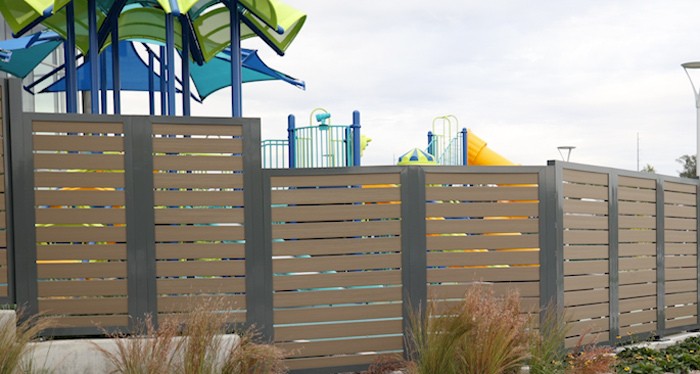
Secure campus perimeter — commercial security grade; athletic field surround; HVAC and utility enclosures; portable classroom compound perimeters; controlled entry pedestrian gates.

Correctional Facilities

Minimum to medium security perimeters — 50mm×50mm, 4mm or 5mm, with rotary topper or barbed wire extension; secondary perimeter fencing; vehicle sally port gate systems.

Transit Infrastructure

Rail and bus maintenance yard perimeters — commercial to medium security grade; utility enclosure surrounds; station back-of-house perimeters; access control gate systems.

Water, Wastewater & Electrical Utilities

Treatment plant perimeters, pump stations, reservoir surrounds, and substation perimeters — EPA and NERC CIP-006 physical security compliance; anti-tamper hardware; intrusion detection integration coordination.

Government, Federal & Municipal

Agency secure zones, law enforcement facilities, public safety campuses, emergency operations centers, and municipal fleet yards — commercial security to high-security tier per facility security plan.

Installation on Active Public Sites

Field Coordination Built for Public Projects

Post Embedment Quality Control

Every post embedment is documented — depth measurement, concrete placement method, and cure time before panel installation. We do not install panels on fresh concrete footings. Minimum cure time is 24 hours; 72 hours on projects with PE-specified curing requirements.

Post Embedment Quality Control

Every post embedment is documented — depth measurement, concrete placement method, and cure time before panel installation. We do not install panels on fresh concrete footings. Minimum cure time is 24 hours; 72 hours on projects with PE-specified curing requirements.

Panel Alignment & Flatness

Welded wire panels are rigid — misalignment cannot be corrected by tensioning after installation. We set all posts to a laser-established line before concrete placement and verify panel flatness and alignment before anti-tamper hardware is torqued.

Panel Alignment & Flatness

Welded wire panels are rigid — misalignment cannot be corrected by tensioning after installation. We set all posts to a laser-established line before concrete placement and verify panel flatness and alignment before anti-tamper hardware is torqued.

Perimeter Security Continuity

On occupied correctional, government, or institutional sites, we develop and execute a Perimeter Security Continuity Plan before mobilization — documenting phasing sequence, maximum open-perimeter window, and temporary security bridging protocols in coordination with your superintendent and the owner's security officer.

Perimeter Security Continuity

On occupied correctional, government, or institutional sites, we develop and execute a Perimeter Security Continuity Plan before mobilization — documenting phasing sequence, maximum open-perimeter window, and temporary security bridging protocols in coordination with your superintendent and the owner's security officer.

Gate Fabrication Coordination

Security-grade welded wire panel gates require shop fabrication matched to the panel system's wire gauge and mesh geometry. We confirm gate fabrication lead times — typically 3–5 weeks for security-grade gates — with your project schedule on day one to avoid delivery delays that hold up perimeter completion.

Gate Fabrication Coordination

Security-grade welded wire panel gates require shop fabrication matched to the panel system's wire gauge and mesh geometry. We confirm gate fabrication lead times — typically 3–5 weeks for security-grade gates — with your project schedule on day one to avoid delivery delays that hold up perimeter completion.

Underground Utility Coordination

All post locations are confirmed with 811/Dig Safe prior to excavation. Post embedment depth and footing diameter are set per PE-stamped drawings, not field estimates — and every footing is logged before panel installation proceeds.

Underground Utility Coordination

All post locations are confirmed with 811/Dig Safe prior to excavation. Post embedment depth and footing diameter are set per PE-stamped drawings, not field estimates — and every footing is logged before panel installation proceeds.

Davis-Bacon Compliance

All applicable projects are executed in full prevailing wage compliance. Certified payroll records maintained and submitted on your required schedule. Personnel background screening initiated immediately upon award for facility-access-controlled sites.

Davis-Bacon Compliance

All applicable projects are executed in full prevailing wage compliance. Certified payroll records maintained and submitted on your required schedule. Personnel background screening initiated immediately upon award for facility-access-controlled sites.

Warranty Coverage

All Warranties Transferable to Project Owner

All warranties are transferable to the project owner upon substantial completion and provided in written form as part of the project closeout package. Extended warranty options available for premium coating specifications and high-security applications.

0y

Workmanship (Labor)

0y

Panel Structural Integrity — Weld Strength

0y

Class 3 Galvanized Coating — Panels & Posts

0y

PVC Coating over Galvanized

0y

Gate Hardware — Manual

0y

Post Structural Performance

0y

Anti-Tamper Hardware

0y

Gate Operators

PROCESS STEPS

What to Expect From First Contact Through Closeout

Step 01

Bid Phase

Send us the fence spec section (CSI 32 31 26), site plan, panel product reference if specified, and bid date. We confirm product family, mesh geometry, wire gauge, security tier, and post schedule — and return a complete scope letter and hard bid within 3 business days. We flag product substitution requirements and spec ambiguities before bid day.

Step 01

Bid Phase

Send us the fence spec section (CSI 32 31 26), site plan, panel product reference if specified, and bid date. We confirm product family, mesh geometry, wire gauge, security tier, and post schedule — and return a complete scope letter and hard bid within 3 business days. We flag product substitution requirements and spec ambiguities before bid day.

Step 02

Award & Execution

Execute your subcontract, provide COI within 24 hours, and immediately initiate PE engineer engagement for structural calculations, gate fabrication order placement, and personnel screening for facility-access-controlled sites. Gate lead times are confirmed on day one.

Step 02

Award & Execution

Execute your subcontract, provide COI within 24 hours, and immediately initiate PE engineer engagement for structural calculations, gate fabrication order placement, and personnel screening for facility-access-controlled sites. Gate lead times are confirmed on day one.

Step 03

Scheduling

We provide a detailed installation schedule upon NTP, with post embedment sequencing, panel installation phasing, and gate fabrication delivery milestones coordinated with your site superintendent. Security continuity plan is reviewed and approved before mobilization.

Step 03

Scheduling

We provide a detailed installation schedule upon NTP, with post embedment sequencing, panel installation phasing, and gate fabrication delivery milestones coordinated with your site superintendent. Security continuity plan is reviewed and approved before mobilization.

Step 04

Change Orders

Pricing provided within 48 hours. We use your preferred CO format and track all T&M work with daily authorized superintendent signatures.

Step 04

Change Orders

Pricing provided within 48 hours. We use your preferred CO format and track all T&M work with daily authorized superintendent signatures.

Step 05

Closeout

Complete closeout package — as-builts, ASTM compliance documentation, PE footing logs, warranties, anti-tamper key chain-of-custody where applicable, maintenance guide, gate O&M manuals, lien releases — delivered within 5 business days of substantial completion.

Step 05

Closeout

Complete closeout package — as-builts, ASTM compliance documentation, PE footing logs, warranties, anti-tamper key chain-of-custody where applicable, maintenance guide, gate O&M manuals, lien releases — delivered within 5 business days of substantial completion.

Frequently Asked Questions

For Project Managers

The spec says "rigid welded wire panel fence" but doesn't name a product — how do we know what to bid?

We review the spec for the controlling parameters: mesh opening size, wire gauge, ASTM reference, and any security performance rating. From those, we identify the qualifying product family and confirm it with the A&E team via RFI before bid day. Your scope letter documents the specific product, mesh geometry, and wire schedule we are pricing — no material substitution disputes after award.

Why do welded wire panel gates take longer to fabricate than chain link gates?

Security-grade welded wire panel gates require shop fabrication of the gate frame and infill panel matched to the specified mesh geometry, wire gauge, and frame section — components not stocked in standard fabrication inventories. Lead time is typically 3–5 weeks from approved shop drawings. We flag this on bid day and place the fabrication order immediately upon award so gate delivery does not hold up perimeter completion.

Does welded wire panel fencing require PE-stamped structural calculations?

Yes — on any installation above 6 feet, in any high-wind zone, or where the specification explicitly requires engineered drawings. Rigid panels transfer concentrated lateral loads to posts in a fundamentally different way than chain link. Post size, wall thickness, embedment depth, and footing diameter must be calculated, not estimated. PE-stamped calculations are a standard submittal deliverable, not an add-on.

Can welded wire panel systems be integrated with access control and CCTV?

Yes, and early coordination is critical. We provide conduit stub-out locations, camera mounting bracket structural details, card reader post mounting specifications, and gate operator structural requirements to your electrical sub and security integrator before rough-in. We do not install electrical or security electronics — we ensure the civil and structural scope supports their installation without modifications.

How does a damaged panel get replaced after project closeout?

A damaged panel is removed and replaced as a single modular unit without affecting adjacent sections. Our closeout package documents the panel removal procedure, the anti-tamper key requirement for hardware removal on security-tier projects, and the panel specification for replacement ordering — so facility managers can manage routine replacements without a fence contractor.

Downloads

Project Resources

Product Catalog

Hog Wire Fence Catalog

Product family reference guide — V-mesh, flat panel, palisade, expanded metal

Mesh opening & wire gauge selection matrix

Panel vs. chain link performance comparison

Post schedule & embedment reference by height and wind zone

Gate system guide — types, weights, operator sizing

Coating specification — galvanized & PVC options

PE-stamped standard detail drawings

Submittal-ready ASTM F2453 product data sheets

Capabilities

Capabilities Statement

Company overview & public sector focus

NAICS codes & license information

Bonding capacity (single/aggregate)

Security project references

Personnel screening & facility access capabilities

ASTM F2453 / CSI 32 31 26 compliance documentation history